Category: Legislation

The TSC Draft Growth Management, Housing and Employment Strategy (Draft GMHES)

CEC Highlighted for speed and ease of reading.

The ‘GMHE Strategy’ implements the NSW State planning policy the North Coast Regional Plan 2041, which requires Councils to “Identify and direct suitable land to accommodate planned growth” “to respond to higher than expected housing demand.” The GMHE Strategy identifies that land.

From the TSC draft GMHES:

“Current population 99,793, growing to 107,125–119,082 by 2041. Previous GMHES work identified a potential upper limit of 128,333.”

“Capacity to deliver approximately 27,400 new dwellings.” [!]

Hinterland villages to grow via boundary expansions (Burringbar, Tumbulgum, Tyalgum and Uki) and infill: (Chillingham, Crabbes Creek and Stokers Siding). read more

Share

The Tweed Rural Housing Issue

CEC Note Regarding the Rural Housing component of TSC’s ‘Draft GMHE Strategy’:

WRT Section D1.5.1, p.60. “Rural Housing.

“Secondary dwellings (granny flats) or dual occupancy (detached) … in the RU1 Primary Production and RU2 Rural Landscape zones. These can occur where:

  • “lots have a minimum lot size of 5 hectares.
  • “secondary dwellings have a maximum [floor] size of 60m2.
  • “the additional dwelling is located no more than 100 metres away from the principal dwelling.
  • “sharing a single property access point and driveway.”

We [CEC] object to the draft 5 hectares minimum lot size for eligibility for the secondary dwelling / dual occupancy.

Our [CEC] position is that such allowance should be only on land over 40 hectares.

———-

Background: The NSW Government’s ‘North Coast Regional Plan 2041’ requires Councils to “Identify and direct suitable land to accommodate planned growth” “to respond to higher than expected housing demand.” Tweed Shire Council have in response published for public comment the draft of their updated ‘Growth Management, Housing and Employment Strategy’, the GMHES, which identifies that land. read more

Share

Submission – Variations and Changes to Complying Development

Summary 

The State is proposing to increase the uptake of ‘Complying Development’ applications to fast track housing.

Complying Development replaces Tweed’s building assessment codes with statewide, cookie cutter, ‘sea of roof’ style, building codes, that bypass consideration of virtually all other Tweed planning controls, bypass public exhibition, and bypass your right to legal appeal. 

The character of our Shire would be stripped away, forming one urban sprawl to the next under these State building codes. 

———-

Submission Objecting to the Proposed NSW Variations and Changes to Complying Development.  

The Caldera Environment Centre objects to the proposed NSW ‘Variations and Changes to Complying Development’ provisions as they apply to Tweed Shire. read more

Share

Submission: Low Rise Housing and Targeted Assessment Pathways

Summary:

The State is proposing another, whole new development pathway, called Targeted Assessments. This would be for virtually all other residential developments that still doesn’t fit the Complying Development criteria. 

The State’s cookie cutter building codes would again replace Tweeds building codes for these Targeted Assessments, and Tweed’s other planning and environmental controls would be weakened so much as to be virtually ineffective except in the most extreme cases.

Tweed has the highest number of threatened species in Australia, is a fragile, steep, wet, active, erosion caldera, and has an urban population within the midst of this stunning ‘National Iconic Landscape’.  We have an obligation to protect this region in Australia’s public interest.  read more

Share

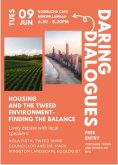
Housing and the Environment – Finding the Balance: Mur’bah Daring Dialogues

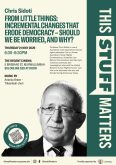
With the NSW removal of public consultation for neighbouring buildings approval, with the TSC vote to permit un-rate-chargable second remote dwelling construction, with the public apathy of defeatism … what on earth will become of the landscape ecology and what can be done to arrest the building out of the Tweed rural and natural environment. A Daring Dialogue at the Kambucha Cafe Tuesday 9th June 6.30pm.

Please also be aware of the Draft Growth Management Housing and Employment Strategy (GMHES) (soon up for exhibition) and a new fast track proposal by the state that will bypass the low rise housing (1-2 storey) DAs and their local conditions such as site placement, compensatory bush regeneration etc.  read more

Share

NSW Government’s Forest Industry Action Plan, Consultation Report Released

Stakeholder Consultation Report, attached, interesting bits highlighted for quicker reading.

Highlights:

Submissions from more than 1500 individuals and 160 organisations.

Viewpoints and evidence in support of environmental concerns tended to submit that:

• Native forest harvesting in NSW has major impacts on biodiversity and endangered species and should cease as soon as possible.

• Healthy, protected and intact forests are intrinsically, socially and culturally valuable.

• The forestry industry does not have the capability to deliver beneficial environmental outcomes.

NEFA: “Stakeholder Consultation Report confirms the public want an end to logging public native forests.”

“The Stakeholder Consultation Report for NSW’s Forestry Industry Action Plan (FIAP) raises more questions than it answers, though with 70% of submissions expressing support for ending native forestry it confirms that most people want an end to this archaic and destructive industry. read more

Share

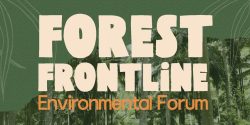
Forest Frontline Forum

On March 21, at the Southern Cross University campus, hear from frontline campaigners and local experts who know the forests best, to hear about the plan to secure protection for Richmond River Koala Parks.

This is a chance to understand what’s at stake – and how protection is possible when our community stands together.

Share

They are removing the environmental protections from the Environmental Planning and Assessment Act [!] .

Key purposes of the Act until now have been: to ensure that ‘development’ is done in an environmentally sustainable way; to protect the environment; to ensure community participation – they are rewriting it so that they can ignore all of those things.

Example: One of the many changes is a new assessment pathway that is “unconstrained and expressly prohibits consideration of environmental impacts and the public interest.” note the EDO.

The intention behind the changes is to allow development in otherwise environmentally protected areas.

The Act is New South Wales’ primary legislation for land use planning and development assessment. It governs environmental planning instruments like State Environmental Planning Policies (SEPPs) and Local Environmental Plans (LEPs). read more

Share

[nefanews] Will the Feds save forests?

There has been some hope that the Federal changes to the EP(BC) Act (the Environmental Protection and Biodiversity Conservation Act) may result in improvements for native forests, such as by adopting and applying strong  environmental standards that over-ride RFAs, though an assessment of the new laws by EJA maintains that we will be worse off on most counts (https://envirojustice.org.au/environment-law-reform-scorecard/). EDO also consider that the positives are undermined by extensive exemptions and opportunities for ministerial discretion (https://www.edo.org.au/2025/10/31/epbc-act-reforms-make-it-to-parliament-edos-first-impressions/). It seems that for forests we will still suffer under 25 year old “evergreened” RFAs, applied through nice sounding intents, such as ‘ecologically sustainable’ and ‘adaptive management’, that can actually mean whatever the Governments want (usually nothing). Given that we already have species recovery plans that are meant to apply to forestry, but in practice make no difference, it seems the national standards will be more of the same. read more

Share