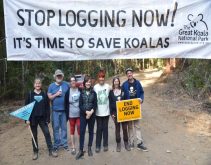
NEFA: “It’s been a huge start to the year with communities rising up to protect what’s left of our precious native forests.
An Opportune Time
Now is our chance to bring the logging of public native forests in NSW to an end. The prospects are great, with a minority ALP Government, beholden to independents, many of whom want an end to logging, and The Greens in the Lower House. And in the Upper House the ALP need The Greens to pass legislation, with one of their key demands being to stop logging of public native forests.
The economic and environmental cases for ending logging have never been clearer. Most recently the conservative Blueprint Institute demonstrated “conclusively that there is no economic case for continued logging of native forests on the North Coast of New South Wales”.
With logging causing populations of many forest dependent species to rapidly decline, spreading weeds, causing widespread dieback, reducing stream flows, and increasing fire risk, there is a need for immediate action.
As climate heating gathers momentum, the increasing temperatures, droughts, heatwaves and wildfires are compounding logging impacts, as demonstrated by the 2019/20 wildfires burning half north-east NSW’s forests and decimating populations of numerous species within the firegrounds.
We urgently need to help our forests recover from past abuses, allow them to sequester atmospheric carbon out of harms way, regrow big trees for nectar and hollows, and regain their natural resilience. And we can make money at the same time.
Now is a time of unprecedented opportunity. Our forests need you to stand up, speak out and take action to make an end to logging of public native forests a reality within this term of government.
Blueprint for a greener future.
On April 27 the conservative think tank the Blueprint Institute launched an economic report on logging of north-east NSW’s public forests in parliament house, shocking the logging industry with their finding “conclusively that there is no economic case for continued logging of native forests on the North Coast of New South Wales”.
Their report ‘Branching Out: Exploring Alternate Land Use Options for the Native Forests of New South Wales’ assesses the economic potential of native forest conservation by modelling the value of carbon sequestration and tourism against continued logging, finding that managing the North Coast region in a manner consistent with conservation would over the period from now to 2040:
- abate an average of 0.45 million tonnes of carbon annually, which equates to a net present value of $174 million
- increase tourism to the region, providing a net present value of $120 million.
After allowing for an Industry adjustment package of $215 million and generous assumptions of potential yields, the Blueprint Institute identified a net benefit value of $45 million in present-day dollars by stopping logging immediately.
They note “logging of native hardwood forest on the North Coast is a loss making enterprise, subsidised by Forestry Corporation of New South Wales’ (FCNSW) profitable softwood plantation division, along with the taxpayer via periodic equity injections from the state government. Based on its own merits, we find that FCNSW’s native hardwood division is not commercially viable”.
NEFA considers their figures on carbon sequestration grossly understates the uptake of atmospheric carbon by recovering forests, and thus the benefits of ceasing logging. Further to this there are the economic benefits of increasing water yields to streams and reservoirs as forests age – regrowth uses 2-3 times the water of old forest, leaving far less to enter streams. The environmental benefits are priceless.
Accounting for fauna
NEFA’s legal challenge to the North East NSW Regional Forest Agreement (RFA) was heard in March 2022, and we are still waiting for the judgement. If we are successful in getting the RFA invalidated it will mean the Forestry Corporation’s exemption from the Commonwealth’s Environment Protection and Biodiversity Conservation Act will cease, creating an opportunity for us to instigate legal proceedings to protect federally listed species.
Further to this, on behalf of native title holder David Mundine, Al Oshlack has challenged harvesting plans for 5 compartments in Cherry Tree State Forest (in the headwaters of the Richmond River) on the grounds that they do not implement Ecologically Sustainable Forest Management. NEFA’s Dailan Pugh, was an expert witness in the case. The case was heard in the Land and Environment Court in early April. Should it succeed, it will create opportunities for further legal challenges to harvesting plans.
The new NSW Government has committed to creating a Great Koala National Park, though they refuse to implement a moratorium on logging while their assessment is undertaken (which could take years), allowing core Koala habitat to be logged in the interim.
For these reasons, NEFA has engaged experts to undertake a series of surveys of forests proposed for imminent logging. The surveys are focusing on federally listed threatened species, including Koalas, with the intent of collecting evidence on species distributions that we could potentially use in future court cases, should either of the current cases be successful.
At the very least we hope to be able to use the results to convince the NSW Government to stop logging Koala habitat we identify, and to pressure them to implement pre-logging Koala surveys of their own.
Great Koala National Park
Almost 50 people gathered in Coffs Harbour last week to discuss the way forward for the Great Koala National Park. How do we turn it from a promise to a reality and get the best possible outcomes for Koalas.
There are now more than a dozen local groups within the footprint of the proposed park, each gave a short presentation and all are passionate to see the logging stop immediately before the environmental values and koala habitat are further degraded by Forestry Corporation.
Ashley Love gave an historical perspective, Dailan Pugh talked about the legal situation, Tim Cadman presented a map showing the areas planned for logging and Grahame Douglas talked about the difference between the NPA map and the map in the Greens bill to Parliament.
Lots of ideas in the mix as well as data gathering. If you want to be more involved in any aspect of the campaign, contact your nearest group or ask us, and we’ll put you in touch with someone.
Forest Updates
Doubleduke State Forest
NEFA have been working with local groups to stop logging of the Gully of the Giants in Doubleduke State Forest, west of Evans Head. The Forestry Corporation is logging old growth forest mapped in 1998, which is part of an unburnt fire refuge identified by the Environment Protection Authority (EPA) in 2020 to be protected from logging as a source area to allow recolonisation of the surrounding extensively burnt forests. The EPA refused NEFA’s request to intervene to reinstate their protection for this exceptional and vital refuge in a heavily burnt landscape.
The Gully of the Giants has been a site of ongoing community scrutiny and non-violent direct action since logging operations moved into the valley in January 2023. On March 10 Valerie Thompson held up logging for 30 hours while occupying a tree-sit attached to logging machinery, and on April 4 former Federal Greens candidate Kashmir Miller did the same for 8 hours, bringing widespread public attention to the values of the forest. A public open day at the forest on March 16 attracted almost 100 people and a strong police presence.
The Forestry Corporation is required to identify and protect “giant trees” (exceptionally large trees over 1.4m diameter). On March 10 NEFA complained to the EPA that giant trees had not been mapped properly in a proposed logging area, resulting in the EPA guaranteeing they would. A month later NEFA complained that two giant trees had been felled, and further giant trees had not been properly mapped, resulting in the Forestry Corporation agreeing to a request from the EPA to stop work while the trees were properly mapped (as the EPA had earlier promised).
Forest protectors were elated that logging was stopped on April 14, though the EPA soon allowed logging of this irreplaceable oldgrowth forest and fire refugia to resume, and are unwilling to take any action on the breaches identified. This madness needs to stop.
Newry State Forest
NSW Forestry Corporation has recently re-listed Newry State Forest as ‘approved’, which means they are intending to industrially log this native forest any day now. Locals are ready to gather again at Camp Nunguu on Saturday 13th May to send a strong message to NSW Forestry Corporation and the NSW Government that our community is still here, and that they’re willing to take action!
Camp Nunguu was established 2 years ago and was temporarily successful in protecting Newry Native Forest from logging. All are welcome and encouraged to attend! Whether you have been a part of the many who built and held camp in the past, or if you are keen to show your support for the first time. More details here.
Bulga Forest
Save Bulga Forest group is busy with regular citizen science outings gathering data on the values of our forests as well as supporting the nine people arrested over the summer trying to bring some focus to the devastation being wrought on the public’s forests. So far two of those convicted for stopping logging by sitting in tripods, have been given 9 month good behaviour bonds, now known as Conditional Release Orders. The others are all waiting for their day in court. We’re showing the Bob Brown film, The Giants in Taree on June 4 as a fundraiser. If you live near enough come along. Tickets here.https://events.humanitix.com/the-giants-film-screening
Redbank Power Station
The Redbank power station proposal refuses to die. It is proposed to open what was a polluting coal power station and convert it to a giant wood-burning polluting power station. Despite the federal government passing a regulation ruling out native forest wood going straight to a power station being counted as renewable energy, this dinosaur refuses to face its extinction reality.
The company pushing the proposal has asked the government for the areas it needs to cover in an EIS. The documentation on the Department of Planning website still sees it planning to get hundreds of thousands of tonnes of wood each year from logging and land-clearing. They must be living in an alternate reality. Meanwhile Sweetman’s, the sawmill near Cessnock that was going to supply much of the wood (presumably via installing a woodchipper) is now being touted as a site where plastic waste will be converted to ‘green hydrogen’. Although neither the council nor the neighbours have been told as far as we know.
Carbon storage in old trees
The logging industry often say that young trees are more important for removing carbon from the atmosphere than older trees. Well here’s a handy reference to debunk that particular falsehood.
In 2014, a massive international study in Nature led by researchers with the U.S. Geological Survey showed not only that older trees store more carbon than younger ones, but that their ability to absorb carbon grows continually as they age. The research, based on direct measurements of more than 160,000 trees from 400 species covering every forested continent, shattered the notion that young trees can replace the capacity of old trees to remove carbon from the atmosphere in anything close to the amount of time that humanity has to address climate change. In fact, because of soil disturbance after a timber harvest, studies have shown that new young forests release more carbon than they absorb for 10 to 20 years after planting.
Events
Caldera World Enviroment Day Festival
There’s plenty to enjoy at the upcoming Caldera World Environment DayFestival. July 16th.
Sussie Russell will be a guest speaker at the World Environment Day event. “Susie is an effective, long-time forest campaigner. Susie’s recent arrest came as the Save Bulga Forest community ramped up their campaign of civil disobedience calling for an end to logging NSW native forests. “I have no doubt I was arrested in order to try and limit my involvement in the campaign. It has however, made my resolve stronger.” Susie brings us uncensored information from the front lines of NSW native forest protection.”
Aquarius Festival 50th Anniversary – Nimbin May 12-21
Tuesday 16th is a day of activities focused on Politics, Activism and the Environment.
You can read the program here
There will be an End Native Forest Logging stall during the period of the festival. If you can donate a few hours to staff it, that would be appreciated. To help on the stall phone Cathie 0403443594.
On Saturday August 19, we are rallying in key cities and regions of Australia, calling for an end to native forest logging nationwide.
Register here to stay updated with the time and exact location of the rally.