

“This is a code red for environmental protection in NSW.”

NCC: “The NSW Government’s proposed changes to the Environmental Planning and Assessment Act opens the way for reckless developments of all kinds.
“This is a code red for environmental protection in NSW. If passed as is, the reforms on the table would have devastating consequences.”
“These extreme changes to our environmental protection laws would strip away environmental scrutiny, making it easier for damaging developments to slip through.
EDO
TSC DCP Review, An Opportunity to Protect Non-Native Trees As Do Other Councils

The revised Development Control Plan(DCP), when it soon goes on exhibition for Public comment, will be an opportunity to support stronger protection of both native and non-native trees.
Greens Councillor Nola Firth comments:
“Tweed Shire Council compared to other NSW Councils has had scant protection for non-native urban trees.
“Non-natives here in the Tweed were only protected if they had a diameter of more than 80cm at breast height. To bring us into line with many other councils and to keep our precious trees intact, the diameter in the DCP is now 40 cm.’
So please have ‘Your Say’ on this change. It’s also an important opportunity to establish housing and landscaping controls that reduce emissions and urban heat, and protect biodiversity.”
Have Your Say, TSC’s New Compensatory Planting Policy

“The many benefits of trees in urban areas are recognised through Council’s Cool Towns: Tweed Shire Urban Forest Program which aims to increase the average total canopy cover in urban areas from 26.8% to 35% by 2030 and then to 40% by 2040 [!].
“We’re [TSC] asking everyone to help restore our urban forest when trees are removed.
“We’ve drafted a new Compensatory Planting Policy to guide how important trees and vegetation are replaced when they’re approved for removal.
“Please read the New Compensatory Planting Policy draft before submitting your feedback so your input can be properly considered in the final recommendations.
“Share your feedback by 4pm Wednesday 22 October 2025.”
Why the world may be nearing its limits

From The Nimbin Good Times, by Mark Pestell.
In 1972, a group of researchers from the Massachusetts Institute of Technology (MIT), one of the top five Universities in the USA, published a groundbreaking report that would shape the global environmental debate for decades to come. Entitled ‘The Limits to Growth’, commissioned by the Club of Rome (clubofrome.org), the report presented a sobering possibility: if humanity continued to pursue unlimited economic and population growth on a planet with finite resources, global systems could begin to collapse around the year 2040.
http://www.nimbingoodtimes.com/archive/pages2025/nov/NGT-1125-8-15.pdf
by Mark Pestell November 2025 page 14
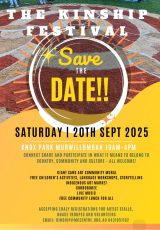
Looking Forward to the Kinship Festival
Vid for TSC & ITV Acquittals ‘About WED’
Great Koala National Park

ON 7 SEPTEMBER THE NSW GOVERNMENT ANNOUNCED THEY ARE GOING TO CREATE THE FULL GREAT KOALA NATIONAL PARK, AN HISTORIC CONSERVATION WIN AFTER A 10 YEAR CONCERTED COMMUNITY CAMPAIGN.
NEFA:
“This park will protect 12,000 Koalas and enable their populations to recover as their feed trees regrow. This is the sort of action we need if we want to double their population in NSW.
“This park will also protect the homes of 108 other threatened species from further degradation, most notably for the nationally Endangered Southern Greater Glider, Spotted-tailed Quoll, Hastings River Mouse, and Rufous Scrub Bird.”
Microbes found in bark enhance benefits of trees
From the Byron Echo Volume 40#32 January 14
Australian researchers have discovered a hidden climate superpower of trees. Their bark harbours trillions of microbes that help scrub the air of greenhouse and toxic gases. It’s long been known that trees fight global warming by consuming carbon dioxide (CO2) through photosynthesis. But a new study published in Science shows their microbial partners take up vast amounts of other climate-active gases too. The study, conducted primarily by Dr Bob Leung at Monash University’s Biomedicine Discovery Institute (BDI), and Dr Luke Jeffrey at Southern Cross University’s Faculty of Science and Engineering, rewrites our understanding of how trees and their resident microbes shape the atmosphere. For more information, contact the Media Office at Southern Cross University at scumedia@scu.edu.au
Redbank ‘Biomass’ Power Station Permit Refused, AGAIN. Woohoo, again.
CEC CoOrdinator Rhonda James presenting at the NSW Weeds Conference
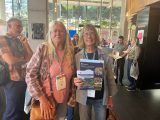
CEC Co-ordinator Rhonda James (pictured left) presented at the NSW Weeds Conference. Rhonda spoke on the keys to the successful 30 year bitou bush management program in The Tweed and Byron Shires.
Rhonda is notably also the Convenor of the Caldera Environment Centre.
“Weeds are one of the top three causes of species extinction (along with habitat loss and feral animals).”
Tweed Shire Councilor Cr. Nola Firth (pictured right) was later interviewed by Tweed Valley Weekly Editor Johnathon Howard on this issue, link to article here: https://calderaenvironmentcentre.org/thursday-coming-tweed-shire-council-monthly-meeting-a-trio-of-environmental-concerns/
Pic: Rhonda @CEC; TSC Councillor Nola Firth.
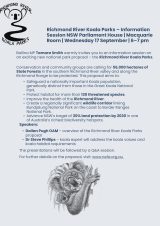
Richmond River Koala Parks proposal presentation by NEFA et al at Parliament House (!)
Three-quarters of all listed weeds in Australia are escaped garden plants!
Petition from Invasive Species Council for Action on the sale of weeds from nurseries.
Australians know that weeds like lantana are choking our streams and bushland.
An astounding three-quarters of all listed weeds in Australia are escaped garden plants, sold legally to unsuspecting shoppers in nurseries or online.
These weedy plants have already contributed to at least four extinctions.
The current system of self-regulation expects passionate home gardeners to have a botany degree or pay close attention to warnings in fine print to stop their garden plants from spreading into the surrounding landscape.
We need urgent action. And while there’s growing political momentum to act, it’s nowhere near fast enough to match the scale of the problem.
Submission In Objection. The Caldera Environment Centre OBJECT in the strongest possible terms to Redbank power station being permitted to burn vegetation from land clearing and from native forest ecologies:
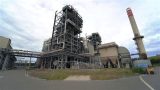
1. We object to the proposal on ecological grounds.
Ecological systems are collapsing around the planet. We are living in the age of The Ecological Crisis, the collapse of the ecology, the collapse of the systems of interrelated and interdependent lifeforms on this planet. In that context we must rescue and protect ecologies, in this case forest ecologies.
Native vegetation ‘biofuel’ is literally the native forest ecologies, destroyed and pelletised to use as fuel for furnaces. Native Forest ‘biomass’ for furnace fuel for electricity destroys ecologies and IS Ecologically Unsustainable.
To clear land of native ecologies in this era is not a correct action and a Redbank approval will itself burn 850,000 tonnes of native vegetation each year, though worse yet it will also be a precedent for other power stations to do likewise, leading to even greater destruction of native ecologies.
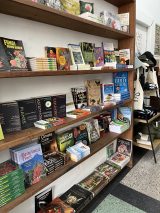
The Caldera Environment Centre Shop
Tweed Shire Council August Monthly Meeting. “A Trio of Environmental Concerns”
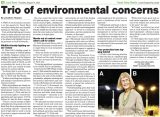
The upcoming TSC monthly meeting is Thursday August 21st.
Note the following agenda items:
- Notice of motion for native animal friendlier night lighting on Council property.
Notice of motion to increase resources towards bushland and urban out of control weeds.
- Councillor Brinsmead – NoM: Review of Council’s Weed Management Practices.
- Note Also: Councillor Nola Firth reporting from her attendance at the NSW Weeds Conference. Cr Firth: Weeds NSW Conference Report.
- Protection of non-local mature trees. Draft Development Control Plan.
See below, Councilor Nola Firth interviewed by Johnathon Howard of the Tweed Valley Weekly on the above items.
Recommended reading.
‘Greenwashing’, Parliamentary Inquiry, “Submissions Welcome”
CEC: “Claims by government agencies that Native Forest Biomass Fuel, fuel for furnaces in the generation of electricity, is ‘Ecological Sustainable’ comes to mind as ‘greenwashing’. The Parliamentary Inquiry however is unlikely to look at the governments own inflated and misleading greenwashing claims, claims which are enabling and subsidising their policies of destruction of native forest ecologies.” And “We have lost faith in the institution of Government in its current composition to protect nature, because of their greenwashing gaslighting and deception, on, for example, the fraud of the ecological sustainability of native forest biomass furnace fuel for electricity generation.”
M-Arts Event: This Stuff Matters > ‘The Serious Role of Creative Arts in Times of Crisis’
STOP CLEARING AND BURNING FORESTS FOR ELECTRICITY, Don’t allow Redbank
NEFA: Please object to the Restart of Redbank Power Station by burning 850,000 tonnes of native forests each year, obtained from landclearing. SUBMISSIONS NEEDED BY 5:00pm on Monday 18 August 2025. MAKE YOURS NOW.
This month NSW’s Independent Planning Commission is deciding whether to approve a massive increase in landclearing in western NSW to burn 850,000 tonnes of ‘biomass’ each year into a disused coal powerplant at Redbank, near Singleton in the Hunter Valley.
This will be Australia’s first conversion of coal fired powerplant into a wood fired one.
The Independent Planning Commission is deciding Verdant Earth Technologies Limited’s proposal to restart the disused Redbank Power Station near Singleton by burning 850,000 tonnes of biomass from native forests each year. The original intent was to obtain the biomass from intensified logging operations, now they are saying it will mostly come from landclearing. This will require significant increases in the rate of landclearing, at a time when we need to stop it. There is nothing ecologically sustainable about clearing tens of thousands of hectares of native vegetation inhabited by millions of native animals, and converting it into carbon dioxide to worsen climate heating. To make matters worse they are claiming the 1.3 million tonnes of CO2 released when the wood is burnt doesn’t really exist, claiming it is clean and green because there are no emissions what-so-ever.
The Tweed River District Official Tourist Guide, Murwillumbah – The Centre of Tourist’s Routes.

pdf – Scenic Beauties of the Tweed River District, Official Tourist Guide, Murwillumbah – The Centre of Tourist’s RoutesDownload
“The Upper Tweed affords scenes of beautiful fertile valleys, lofty mountains and hills, bold cliff and rugged bluff, all having rich and varied vegetation.
“… a great wealth of choicest timber trees, including Cedar (red and white), Teak, Beach, Baligum, Sasafras, Cudgera, Black and Redbean, Rosewood, Beefwood, a large variety of Fig trees, and numerous varieties of giant scrub trees, besides the various giant hardwoods in the forest areas.
“Of this wonderful scenic district, Murwillumbah, on the Tweed River, between a horseshoe range of mountain peaks and the sea, is an ideal centre for tourists.
“Destroyed by fire in 1907 it arose from its ashes, rebuilt in improved form – the centre of fertile converging valleys.
NEFA: The North East Forest Alliance
NEFA LAUNCHES CAMPAIGN FOR RICHMOND RIVER KOALA PARKS
NEFA have started a campaign for 56,200 hectares of public native forests in the southern Richmond River valley and on Richmond Range (south of the Bruxner Highway) to be created as the Richmond River Koala Reserves. This is largest stronghold of koalas in the Richmond catchment, a genetically different population from that found in the Great Koala National Park (see below). Protecting these forests will also help over 130 other threatened species and improve the health of the Richmond River.
It is proposed that 56,200 ha of State Forests in the southern catchment of the Richmond River valley and along the southern Richmond Range be created as the Richmond River Koala Parks. These parks will:
- protect the largest area of Koala habitat in the Richmond catchment and habitat of 130 other threatened species,
- help restore the health of the Richmond River by increasing stream flows in dry times and reducing flooding and sediment runoff in wet times, and
- create a regionally important wildlife corridor along the Richmond Range from Bundjalung National Park to the Border Ranges National Park.
These parks encompass 40,000 ha (5.7%) of the Richmond River Catchment, including 37,800 ha (21%) of the Bungawalbin Creek sub-catchment. The proposed parks extend from the floodplain up into the headwaters on the Richmond Range. Forests are an important part of the water cycle, recycling rainfall back into the atmosphere (cooling the land in the process), storing water and releasing surplus water into streams. As the forests recover from past logging the maturing forests will moderate streamflows, increasing baseflows in dry periods and reducing peak flows and flooding in rainfall events.
The years-long review into rodent poison killing native animals is still…
World Environment Day Festival Success, with Expert Speakers, Live Music and Community Action, Well Done to all concerned!
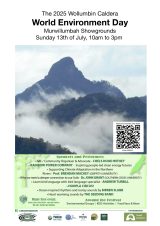
The festival on 13 July celebrated biodiversity and climate solutions in the Northern Rivers.
The World Environment Day Festival returned to Murwillumbah on Sunday 13 July, bringing together the community for a day of environmental education, live music, and collective action from 10am to 3:30pm.
Hosted by Tweed Landcare and the Caldera Environment Centre, this year’s free festival shone a spotlight on the region’s unique biodiversity while promoting practical solutions to climate and conservation challenges facing the Northern Rivers.
The event was MC’d by Community Advocate and Organiser Chels Hood Withey, with an impressive lineup of expert speakers addressing critical environmental issues.
The Caldera Environment Centre “Still the best Environmental Bookshop in the Northern Rivers”, looking forward to the World Environment Day event.

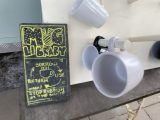
Cup Library at The Padock Coffee Shop
TSC: 1000 trees community tree planting for National Tree Day, Byangum, Sunday 27 July, and, Grants of up to $4,000 for Tweed farmers for sustainable land management.

TSC Tweed Link:
1000 trees community tree planting for National Tree Day! Col Wiley Park, Byangum,Sunday 27 July, from 9 am to 12 noon to help improve water quality, protect wildlife and reduce river erosion.
Also, grants of up to $4,000 for Tweed farmers for sustainable land management for projects that improve soil health, water management, biodiversity and more.
NPWS: Border Ranges 360 degree experiences

“Discover some of the rare and remarkable animals, plants and habitats that make Border Ranges National Park special, with our [NPWS] interactive 360-degree images.
The Border Ranges is a special place where primitive plants and animals have evolved and landscapes have barely changed in millions of years. As a refuge for many threatened species, some areas in the park have been declared Assets of Intergenerational Significance, giving them extra protections.
Swipe, zoom and click the popup pins to explore each 360 experience.
Meeting with Premier and cabinet – July 30 Tweed Heads
TSC residents can attend a special local meeting with Premier and Cabinet on July 30 Twin Town Club 12 noon -1:15 to talk about Tweed issues.. (People have to register.)
It could be a chance to ask for koala protection across the whole state not just on the coast, permission for Council to have an environmental levy, or more funding for Devils Fig and not just for the top weeds, for changes to zombie developments that have environmental protections no longer allowed or whatever else residents want.
“Tweed Community Cabinet Community Cabinet will be held in Tweed Heads on Wednesday 30 July. The Tweed community is invited to attend a Community Forum at Twin Towns Clubs and Resorts, Tweed Heads, from 12:00pm-1:15pm. At this event, attendees will be provided the opportunity to take part in a Q&A session at which they may be able to ask the Premier and Cabinet Ministers questions about topics …” Community Cabinet | NSW Government
Great Koala National Park

Open letter to Premier Minns and the NSW Government
January 10, 2025.
IT IS PAST TIME FOR THE MINNS GOVERNMENT TO STOP LOGGING THE GREAT KOALA NATIONAL PARK. THEY MUST HONOUR THEIR COMMITMENT TO PROTECT IT.
The Minns’ Government was elected on a promise to save Koalas and create the Great Koala National Park, but instead they have increased logging, 21 months later they have logged 7,185 hectares of the park, 8.4% of its loggable area, and refuse to stop. This likely encompasses the homes of over 500 Koalas, along with another 37 Threatened Species.
In January 2015 the NSW ALP opposition leader Luke Foley first promised, if elected, to create the 315,000 hectare Great Koala National Park (GKNP), incorporating 175,000 ha of State Forests and 140,000 ha of existing reserves. This commitment was also taken to the 2019 election.
NSW Parks: Sounds of nature: Border Ranges Gondwana Rainforest

“Listen to our (NPWS) Gondwana Rainforests soundscape on the NSW National Parks, to be transported to this incredible part of Australia.
Border Ranges National Park forms part of the Gondwana Rainforests of Australia World Heritage Area, which stretches past Newcastle to south-east Queensland. The Gondwana Rainforests are globally recognised as home to the most extensive areas of subtropical rainforest in the world, plus most of the world’s Antarctic beech cool temperate rainforest. These extraordinary areas contain ancestors of ancient and primitive plants and animals.”
Plastic Reinforced Paper Tea Bags: We are ingesting millions of nano particles of plastic per cup of tea
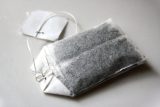
We are all becoming more aware of unwanted ingestion of plastic molecules and the retention of these molecules in our bodies.
The paper of many popular brand tea bags are strengthened with plastic because otherwise the paper tea bag would fall apart in the hot water.
When a plastic strengthened tea bag goes through the temperature change of being immersed the hot water when making a cup of tea, thousands of micro and millions of nano sized plastic molecules fracture and fragment away from the plastic of the plastic strengthened paper tea bag into your cup of tea. [Source: (link).]
The plastic nano molecules we ingest accumulate in our brains, we don’t know why, however plastic accumulates in our bodies mostly in our brain, Plastic accumulates in the brain at ~10 times higher levels than in the liver or kidneys (91% vs. 4% and 4% of total plastic mass in these organs), at a rate of millions of nano particles of plastic ingested per cup of tea. [Source: (link).]
ReUse: $4 Refill Tablet for household cleaning spray containers, at the CEC.

Plastic production reduction – don’t buy a new plastic spray bottle of cleaner each time, instead use an empty plastic spray bottle or get a glass spray bottle from us, then add the refill tablet, and then add water.
The refill tablets are available at the Caldera Environment Centre, $4 each.
“The tablets are 100% natural. Made with essential oils and plant-based ingredients.”
“Easy to use, Lovely Scents, Effective Cleaning, Safe for sensitive kids”
Not dwelling on the subject here, but plastic spray bottle production and disposal is a literal ecological nightmare for the very near future. You want it all to change, but it won’t.
However, for your own mental health, refill your empty spray bottle with a refill tablet and add water.
The Draft Hastings Point Headland Management Plan

Council sought feedback on a draft management plan for Hastings Point headland. The plan aims to improve the quality of this public open space while protecting the headland’s natural environment and cultural heritage values, both now and in the future.
Caravan Park at Pottsville refused by NSW.gov, as per Community and TS Council Recommendation.

Tweed Link #1400 4 June 2025:
“The Northern Regional Planning Panel (NRPP) recently announced their decision to refuse the application (DA 25/0011) at Pottsville. The Development Application for 1183 Cudgera Creek Road, Cudgera Creek included the building of a caravan park containing 267 long term sites and 12 short term sites, clubhouse, outbuildings and associated roads.
The NRPP was the deciding body for the application as it was valued at more than $30 million dollars, a higher amount than can be approved by Tweed Shire Council.
Ultimately their determination – which was unanimous – was based on the idea that a key part of the infrastructure (the effluent dispersal area) required for the caravan park was located on land that was not zoned for such a use. However, they also considered a wide range of concerns outlined by the Tweed Shire Council in their submission to the Panel.
FoodAware Murwillumbah , this July’s Daring Dialogue at the Kambucha Cafe
“FoodAware Murwillumbah is a community project that has been set up to share with the community the knowledge needed to make informed food choices in the light of recent findings on the links between climate change, deforestation and animal farming, the leading driver of climate change, arguably of greenhouse gases as well, and to spell out the urgent need for a demand-driven transition to plant based agriculture.
“A FoodAware Murwillumbah community project team member is Gerard Wedderburn-Bishop,
A leading analyst of global warming causes, a former principle scientist with Queensland’s Natural resources Department, Executive Director of the World Preservation Foundation and author of ‘Eating Our Way to Extinction’ on which the internationally premiered film of the same name is based.
The Mount Nullum Development Proposal and the Genesis of the Caldera Environment Centre (CEC) 1987-1990

This document discusses the development proposals in Tweed Shire during the late 1980s, focusing on the controversial Mt. Nullum project and the impact of the ICAC inquiry on local politics and environmental activism.
Development Proposals in Tweed Shire
During the late 1980s, Tweed Shire faced numerous development proposals, including the controversial Ocean Blue project and Doug Moran’s Mt Nullum resort. These proposals sparked significant community opposition due to concerns over environmental destruction and lifestyle changes.
An estimated $2000 million in development proposals were planned for Tweed Shire.
The Ocean Blue proposal for Fingal led to an ICAC inquiry in 1989, exposing corruption among local officials.
Tweed Landcare Video – ‘Filling the Biodiversity Gaps connecting Tweed Coast to Border Ranges’

Tweed Landcare’s highly successful signature project. Funded consecutively for the last 10 years by the NSW Environmental Trust Restoration and Rehabilitation grant program enabling Tweed Landcare to work with thirty-three landholders in key locations to bush regenerate over 250 hectares of degraded natural areas.
Dear Tweed Shire Councillor, et al.
We reproduce below a recent CEC correspondence to the Tweed Shire Councillors regarding an upcoming agenda item to do with in our opinion not only issues of disposal, but also with our ingestion of micro and nano plastic molecules emitting from plastic in the environment.
Dear Councillor <name>.
Wednesday’s public access Council Meeting has an item on the agenda to do with plastic in the environment, namely the plastic lawn of a leisure facility and the Council’s Strategic Plan for Holiday Parks.
We would like to draw your attention to our webpage about the agenda item, and to some of the other posts to do with plastic in the environment.
As well as the more obvious issue of disposal, We Are All Ingesting Plastic.
Tweed Shire Council > Monthly Public Access Meetings > Agenda for the upcoming Thursday 19 June Meeting
[nefanews] Forestry Corps Losses

NEFA: “Following the NSW Forest Alliance putting out a media release that was run by the Guardian, cross-benchers have now piled on with a story in the Sydney Morning Herald (see below).
SMH: “MPs call for state government to end its ‘fiscally irrational’ logging.
“A powerful group of state government crossbenchers has again called on the state government to end its loss-making logging of native forests after the Forestry Corporation’s hardwood division posted a $14.9 million loss in its latest half-year results.
In a letter sent to Treasurer Daniel Mookhey on Friday, the 12 MPs described public native forest logging as “one of the most fiscally irrational and environmentally destructive practices currently being maintained by this government.
The MPs said it was costing taxpayers tens of millions of dollars a year to destroy ecologically valuable forests, despite the potential for jobs in plantations.
Tweed Regional Art Gallery: Spiders of Paradise

10 May – 3 August 2025, Maria Fernanda Cardoso: Spiders of Paradise presents the artist’s ongoing photographic series featuring the tiny Australian Maratus spider. It includes new works from this series as well as Cardoso’s acclaimed video work On the Origins of Art I–II (2016). Bringing together science, art and nature, this exhibition celebrates the beauty of the natural world and reveals the sophisticated lives of creatures that are not usually witnessed. Maria Fernanda Cardoso: Spiders of Paradise is an exhibition developed and toured by the Museum of Contemporary Art Australia.
Forestry continue to haemorrhage money
From the North East Forest Alliance, NEFA News:
“Forestry Corps have declared a half year normalised earnings loss of $14.9 on their hardwood logging, in part blaming protests, protection of Koala hubs in the GKNP, the new Greater Glider protocols and having to assess the unique and special wildlife values in plantations. The claimed significance of these beggars belief, when their core problem is that their royalties don’t even cover the costs of cutting down the trees and transporting them to the mills.
Timber production and financial results remain below expectations
The ongoing depression in new housing construction was reflected in below average timber sales during the reporting period, particularly for the high quality softwood timber that is predominately used to construct house frames. Expenditure control measures continued to be effective, however financial returns remained well below previous years. Hardwood timber production also continued to be constrained by regulatory changes reducing timber supply in coastal native forests as well as wet weather and protest disruptions. Force majeure notices were issued to customers in northern NSW due to the impacts of changes to regulatory protocols that prevented harvesting in koala hubs
Nature Conservation Council
Links to Nature Conservation Council website, recommended.
Environmental Protection Agency .gov Prosecutes Publicly Owned Logging Authority for Environmental Non-Compliance – Again.
The Forest Alliance NSW has welcomed the NSW Environment Protection Authority’s (EPA’s) decision today to prosecute Forestry Corporation of NSW (FCNSW) for 29 charges. The charges related to illegally logging of critical Greater Glider habitat in Tallaganda State Forest on the NSW South Coast.
The EPA alleges these actions contravened conditions of the Coastal Integrated Forestry Operations Approval (CIFOA), the Forestry Act 2012, and the Biodiversity Conservation Act 2016. Further information available here
The EPA appeared before a Budget Estimates hearing.
Former independent member of NSW Parliament and spokesperson for the Forest Alliance Justin Field said: “the Alliance and the community welcomes the decision to prosecute.”
Tweed Shire Council > Strategic Plan for Holiday Parks > Concerns about Plastics In The Environment.

Note that the Tweed Council 15th May Monthly Meeting Agenda Items includes: “Synthetic Grass in Tweed Holiday Parks”, submitted to the meeting by the Director of Sustainable Communities and Environment.
The agenda item reads:
“At the Ordinary Meeting held 18 July 2024, Council resolved to endorse the Tweed Holiday Parks 2023 -2034 Strategic Plan. Within this resolution, Council required the General Manager to finalise and bring back a report on potential risks associated with the use of synthetic grass in Holiday Parks, alternatives to its use and a detailed asset management plan to best manage the use of synthetic grass in the Holiday Parks to mitigate the risk of microplastic and Perfluoroalkyl and polyfluoroalkyl substances (PFAS) pollution and to ensure recycling at the end of life of the product.
Event at M-Arts, Politics of Life presents ‘Now or Never, Building Resiliance in the Midst of Climate Chaos’

[nefanews]: Axe falls on loggers’ plan to avoid battle over gliders

[Caldera note: A recent court case determined that private people or entities could not take legal action against logging operations carried out in breach of regulations, and that only government entities had that right. The current court case has over-ruled that finding, opening the courts to individuals and groups to pursue legal action against logging operations which are in breach of regulations. This is important as the NSW Government has been protective of logging operations and has refused to take action against breaches of regulations.]
“Environmentalists have hailed a High Court decision in their battle to protect habitat for gliders.
The nation’s highest court has kept the door open for environmental groups to prosecute law-breaking loggers when regulators won’t, dealing another blow to the native timber industry.
Welcome to the new CEC location

Now, after two years without a premises, the Caldera Environment Centre and Shop is back in Murwillumbah.
As before, the centre and shop is operated by volunteers and is open week days and Saturday morning.
Drop in to our centre about the environment, or to shop for environment books, for adults and children, and we have a great selection of locally indigenous rainforest trees for planting, including bush-tucker food trees, lomandras, birdwing butterfly vine plants and more, and a range of selected merchandise, all natural and friendly.
Caldera Activities: World Environment Day is back again on Sunday 1 July at The Showgrounds, Murwillumbah. There is a great line up of stalls, speakers, entertainment and displays.
CEC Movie Club – ‘ALBATROSS, A Love Story’

A highlight of the movie is the slow motion footage of the albatross mating ritual, turning a chaotic cacophonous flurry into an elegant and choreographed mating dance.
Also, the National Parks guide pushes away the grass growing through the nests, revealing the skeletal remains of the chick in the nest, the small pile of plastic in its stomach reveals the cause of death, nest after nest.
The movie ALBATROSS, a film by Chris Jordan.
“… a poetic guided tour into the depths of your own spirit.
… a message of life and love for nature.
… a visual journey into the heart of an astonishingly symbolic environmental tragedy.
The Midway Atoll is home to the largest albatross colony in the world. More than 1.5 million of these birds make their home there, thousands of kilometers away from any continent. A protected wildlife refuge since 1988, Midway ought to be an incredibly pristine, beautiful, natural sanctuary for these birds. Yet, like all creatures, they have to navigate today’s world.