Category: Biosphere

The Wollumbin Caldera – It’s Geological Formation and Flora

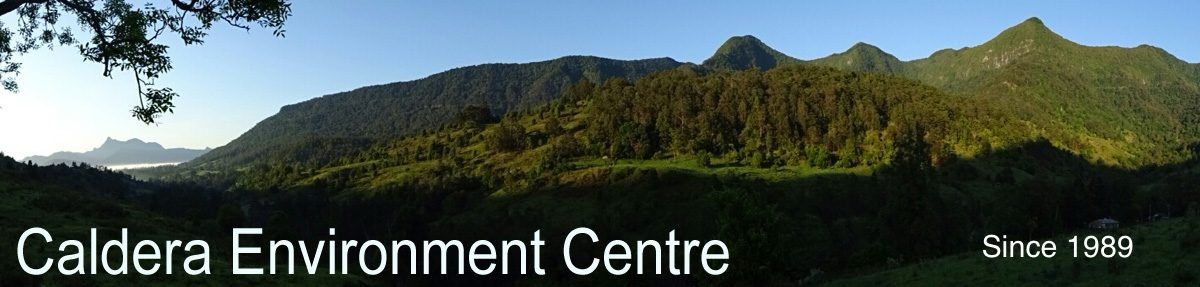
The Wollumbin / Mount Warning shield volcano and its erosion caldera is a unique volcanic landform which has functioned as a refugium, over the 20 million years since it’s formation, for a core area of Gondwana rainforest flora.

The Caldera is located in a major climatic transition zone, between temperate and tropical floral and faunal species, giving high species diversity under a wide range of habitats, its volcanic origins and very high localised rainfall make this a very complex and interesting landform. read more

Share

The Wollumbin Caldera

Text in progress, apologies.

——

A ‘Caldera’ is the geographical remnant of an extinct volcano.

… the soft red volcanic soil washed away over eons, revealing the circular landscape feature of the outer wall of the caldera, formed from a harder magna material inducted below the surface, with the central hardstone ‘plug’ of the volcano remaining as Mount Warning / Wollumbin.

A particular ecosystem existed within the geographical landscape of the Wollumbin Caldera, for eons, different from the surrounding landscape, a biosphere of unique and diverse lifeforms, a wonder to behold, almost completely destroyed for the extraction of ‘timber’ for the hardwood sleepers of the London underground railway system. read more

Share

Land-Clearing Must Stop

The North East Forest Alliance is calling for an immediate halt to land-clearing in the light of the Natural Resources Commission’s damning review showing that land-clearing has skyrocketed, the promised off-setting is not being implemented, Areas of Outstanding Biodiversity Value are not being protected, the regulatory map has not been released, and that land-clearing represents a biodiversity risk across north-east NSW.  
“This follows a damning report from the Auditor General last year finding the regulation of land-clearing was fraught with problems of weak processes, poor assessments, inadequate protection, limited monitoring and poor enforcement, NEFA spokesperson Dailan Pugh said.
“We are in a climate and extinction emergency, clearing more vegetation and releasing its carbon into the atmosphere is pouring more fuel onto the fire, it has to stop.
“Last year over half of north-east NSW’s remnant native vegetation was burnt with the likely death of over 350 million native mammals, birds, lizards and frogs, including thousands of Koalas.
“Many species of plants and animals have had their populations decimated and are teetering on the brink of extinction, it is outrageous that the NSW Government is now allowing land-clearing and logging to push many populations over the brink.
“The Natural Resources Commission’s belatedly released July 2019 report on land-clearing  gives another damning assessment of NSW’s land-clearing free-for-all, it is no wonder the Government suppressed it for so long.
“The NRC reveals that from June 2018 until May 2019, 45,553 hectares was approved to be cleared under the Government’s new Land Management (Native Vegetation) Code, excluding “invasive native species”.
“This was a massive increase from the average of 2,700 hectares per year between 2006/07 and 2016/17.
“Though the NRC are scathing in their assessment that the Government is only setting aside in protected areas a fraction of the area approved to be cleared, when the Government promised they would protect 2-4 times more than was cleared.
“On the north coast the NRC reveal only one fifth the area of the land cleared is being set aside, and this drops down to less than a tenth on the New England Tablelands.
“As the NRC point out, in the second reading speech to Parliament for the Biodiversity Conservation Act 2016, the then Minister for Primary Industries Niall Blair stated that ‘for each hectare cleared under the framework, it is estimated that between two and four hectares will be set aside and managed in perpetuity’ in order to conserve biodiversity values.
“The difference is even starker if the clearing of ‘invasive native species’ is accounted for as the Auditor General’s report last year identified that over 140,000 ha was also cleared under this dubious category.
“Because of the abject failure of the Government to live up to their promise to parliament, the NRC found there was a high biodiversity risk with nine of the eleven regions exceeding their biodiversity trigger thresholds.
“Land-clearing must stop, at least until there is a full assessment of the impacts of the bushfires on our imperilled wildlife, and the Environment Minister has fulfilled his responsibility to identify Areas of Outstanding Biodiversity Value, such as core Koala habitat, for protection.
“Land-clearing increases regional temperatures, reduces rainfalls and releases large quantities of carbon into the atmosphere, we cannot afford for it to continue, let alone escalate. We need to be planting more trees to take up carbon, not bulldozing them.” Mr. Pugh said. read more

Share

Invitation to join Biosphere Project

From Hop E.  The Caldera Environment Centre Inc (CEC) invites local community groups and individuals to form an affiliated coalition to lobby Australian governments (at all three levels) to nominate the Border Ranges bio region as a UNESCO Biosphere Reserve.

Biosphere Reserves were promoted as a conservation/sustainability tool and a major part of the ‘Man and the Biosphere’ (MAB) program arising from the Earth Conference in Rio de Janeiro (1992).

The educational, scientific and cultural arguments and resources for this project are contained in the following documents and DVD’s:

• The UNESCO ‘Biosphere Conference’ (1968).

• The Report from the ‘Club of Rome’, ‘Limits to Growth’ published 1972.

• The Report of the Brundtland Commission to UNESCO, ‘Our Common Future’, published 1987.

• The proceedings from the Earth Conference in Rio de Janeiro (1992) and Johannesburg (2002).

• The proceedings from the United Nations Climate Change Conferences in Kyoto,  Japan (1997); Bali, Indonesia (2007); Copenhagen, Denmark (2009); and recently in Cancun, Mexico (2010).

• The findings of the Intergovernmental Panel on Climate Change (IPCC).

• Reports from the Australian Bureau of Meteorology, CSIRO, the Atmospheric Research Dept., Australian Academy of Science, NASA etc.

• ‘The Living Earth’ by Mary White.

• ‘Remnants of Gondwana’ edited by Kitching, Braithwaite and Cavanaugh.

• ‘The Border Ranges Rainforest Biodiversity Management Plan’ (Commonwealth, Queensland, and New South Wales Governments).

• Northern Rivers Catchment Management Plan.

Local Biodiversity Plan and Bush Futures Plan.

• ‘Byron Underwater’, film on DVD.

• ‘Secrets of the Rainforest’, film on DVD.

“In principle support” has been given by NSW authorities like the Northern Rivers Catchment Management Authority and the North East Regional  Office, of the National Parks and Wildlife Service.  Support was given by the Commonwealth Government Department of Environment some eight years ago.

We ask all participating community groups and individuals to write an old fashioned letter of support on paper to: ”To Whom It May Concern” c/- Caldera Environment Centre Inc. PO Box 5090 SOUTH MURWILLUMBAH NSW 2484 Give your “in principle” support. The main themes of a UNESCO Biosphere Reserve are: • Conservation/Regeneration/Reconciliation of local indigenous wildlife, people and culture. A move towards Ecologically Sustainable Development (ESD)* and triple bottom line accountability. • Respect for and celebration of the natural landscape character and features e.g. headlands, escarpments and ridge lines; streams, rivers and estuaries including riparian buffers. An example of this would be “The Green Cauldron” initiative by the Commonwealth Government. • To act as a living laboratory so we may test ideas concerning sustainability through monitoring and support. *”Sustainable development” would include a concerted and conscious effort to reduce our carbon and ecological footprints, e.g. • Population restraint/constraint • Move towards low carbon industry and economy • Move towards low growth/steady state economy • Cultivation of local organic fruit and vegetables • On-site collection of water, grey water treatment • Composting of household by-products etc. • On-site solar hot water panels, photo-voltaic panels, wind turbines etc. • Sustainable town planning and building initiatives including public renewable electric transport, bicycle and pedestrian paths, affordable and renewable housing etc. The UNESCO Biosphere Reserve concept provides an aspirational model/ template for a worldwide web of reserves.  Ideally, the whole planet should be a biosphere reserve.  There are currently 564 biospheres reserve sites in 109 countries worldwide, and 15 in Australia.  The Border Ranges and Noosa Biosphere Reserves could provide green belt buffers/lungs at either end of the urbanized strip we call the Moreton Basin megalopolis, centred on Brisbane but including the Sunshine Coast and the Gold Coast.  Approximately 250 kilometres of concrete and bitumen.  Give us a break.  Give peace a chance.  For more information on Australia’s Biosphere Reserves go to:  http://www.environment.gov.au/parks/biosphere/ . Or Please find below, ‘Frequently Asked Questions – Biosphere Reserves’, followed by a ‘form letter’ to assist; or please write your own version. Thank You, E. Hopkins (Hop.e) Co-ordinator, Caldera Environment Centre


= = = = =
Share

Press Release- Biosphere Reserve

PRESS RELEASE – Caldera Environment Centre

30/8/2011    From Mr. Paul (Hop.e) Hopkins

Plans to create a biosphere reserve for the Mt Warning caldera are gaining momentum, after receiving support from Tweed Shire Council.

The project, headed by the Caldera Environment Centre (CEC), received unanimous support from the Tweed’s councillors this month.

This month’s Council meeting (Tuesday 16th August 2011) resolved to endorse the centre’s nomination to the United Nations Educational, Scientific and Cultural Organisation (UNESCO) to designate the caldera as Australia’s 16th biosphere reserve.

CEC founder Paul ‘HopE’ Hopkins said the Border Ranges Biosphere Reserve would reconcile the conservation of biological and cultural diversity with economic and social development, by fostering sustainable development.

“Biosphere Reserves have three main functions – conservation, scientific education and monitoring, and sustainable development,” Mr Hopkins said.

“Creating a reserve for this area should stimulate eco-tourism, organic agriculture, education, arts and culture, and should boost Commonwealth funding.

“Our next task will be to convince other governments and win public support – a task made easier by the Council’s support.”

Mr Hopkins said the reserve project would unite several existing programs, such as the Federal Government’s Green Cauldron promotion, UNESCO’s World Heritage Gondwana Rainforest Reserves and the Border Ranges Rainforest Biodiversity Management Plan, which was introduced by all three tiers of government.

Similarly, the reserve would not over-ride existing land use planning instruments. Instead, it is a “symbol of voluntary cooperation to conserve and use resources for the well-being of everyone”.

This is achieved by dividing the biosphere reserve into three zones:

Core – Securely protected areas such as existing National Parks or reserves where biological diversity can be protected and researched. Nature-based recreation and education are encouraged.

Buffer – Public and private land adjoining the cores (often rural land). Encouraging land owners to voluntarily manage their land in sympathy with the core areas, potentially leading to cooperative management strategies for fire, weed and pest control and tourism opportunities.

Transition – Public and private land adjoining the buffer zones (usually residential and commercial land). A successful biosphere reserve is underpinned by voluntary engagement and participation by land users in the buffer and transition zones, often creating marketing opportunities.

“The Mt Warning caldera forms the nucleus of this proposal and should be the first step,” Mr Hopkins said.

“It should then be expanded to embrace the broader region defined in the Border Ranges Rainforest Biodiversity Management Plan, to create a coalition of councils and increase the potential for promotion and funding.”

Council’s Biodiversity Program Leader, Mark Kingston said, “The biosphere reserve would provide formal recognition of the international significance of the region’s biodiversity and landscape and help promote the Green Cauldron as a premier destination for nature-based tourism and green industry sectors”.

Mr. Paul (Hop.e) Hopkins

Coordinator

= = = = =


Share

Biosphere push finds support

Written by Kate McIntosh and Luis Feliu

From the Tweed ECHO    Thursday, 30 June 2011 –

A push to have the Tweed caldera region recognised as an internationally significant ecological site appears to be gathering momentum.
At its meeting last week Tweed Shire Council unanimously voted in favour of a motion to bring forward a report on whether council should back moves to have the Border Ranges region declared a UNESCO biosphere reserve.
The Caldera Environment Centre (CEC), which is leading the campaign, is seeking council support for its nomination.
UNESCO’s initiative, which celebrates its 40th anniversary this week, is designed to balance the protection of high-end conservation areas with sustainable development.
Biosphere reserves typically incorporate one or more protected areas and surrounding lands that are managed to combine both conservation and sustainable use of natural resources.
If the bid is successful, Mt Warning and its surrounding areas would join the ranks of iconic natural wonders including Uluru, the Zambezi and the Rocky Mountains.
‘I think it would enhance the environmental credentials that we already have in this shire,’ Cr Barry Longland said.
Greens councillor Katie Milne also praised the initiative, saying it was a potential tourism drawcard for the region.
‘It would be fantastic if we could realise something like that,’ she said. ‘The Tweed and in particular our caldera: it’s unbelievable what a significant duty we have to protect that.’
However, the CEC’s proposal would still need the federal government’s endorsement before it could be considered by UNESCO.
The Border Ranges National Park straddles the NSW-Queensland border and is home to a high number of rare and threatened species.

The CEC takes this opportunity to say Thank You! to the Tweed Echo for supporting our Border Ranges Biosphere project, this article quoted from the front page – Thursday, 30 June 2011 –  EDITION of the Tweed ECHO.

= = ===

Share